
The Best Educational Toys for Toddlers: What Parents Should Look For
Finding the best educational toys for toddlers can feel overwhelming.
Walk into any toy store or browse online and you'll find thousands of products promising to make children smarter, more creative, or better prepared for school.
But here's the problem:
A toy doesn't have to be complicated to be educational.
For toddlers, some of the best learning happens when they simply pick something up, move it, build with it, take it apart, and try again.
The right educational toys can turn everyday play into opportunities to develop fine motor skills, problem-solving, creativity, concentration, language, and independence.
So how do you know which toys are actually worth bringing into your child's playroom?
In this guide, we'll explain what parents should look for when choosing educational toys for toddlers—and share some of our favorite hands-on options.
What Are Educational Toys for Toddlers?
Educational toys are toys designed to encourage children to learn or practice skills while they play.
For toddlers, this doesn't mean sitting down for a formal lesson.
Instead, learning can happen naturally through activities such as:
- Building
- Sorting
- Matching
- Threading
- Stacking
- Drawing
- Storytelling
- Pretend play
- Problem-solving
- Exploring cause and effect
The best educational toys make children so interested in playing that they don't even realize they're learning.

Why Hands-On Learning Is So Important for Toddlers
Toddlers learn through interaction with the world around them.
They want to touch everything, move everything, open things, close things, and find out what happens when they push, pull, stack, or rearrange something.
That's why hands-on toys can be so valuable.
Instead of simply watching something happen, children become part of the process.
They make a choice.
They try something.
It doesn't work.
They try again.
And eventually, they figure it out.
That simple process helps build confidence and teaches children that they can solve problems independently.
7 Things to Look for in Educational Toys for Toddlers
Before buying a toy, ask yourself whether it encourages your child to actively participate.
Here are seven qualities worth looking for.
1. Does It Encourage Fine Motor Skills?
Fine motor skills involve the small muscles in a child's hands and fingers.
Toddlers use these skills when they:
- Hold a spoon
- Pick up small objects
- Turn pages
- Draw
- Stack blocks
- Button clothing
- Use utensils
- Eventually hold a pencil
Educational toys that involve picking up, placing, connecting, threading, or manipulating objects can give children plenty of opportunities to practice these movements.
For more ideas, check out our guide:
[10 Fine Motor Activities for Toddlers at Home]

2. Does It Encourage Independent Play?
A good educational toy shouldn't always require an adult to explain exactly what to do.
Open-ended toys allow children to explore at their own pace.
For example, a child might use a toy differently from the way an adult expects.
That's okay.
In fact, that's often the point.
When children are allowed to experiment, they practice making decisions and solving simple problems independently.
3. Does It Have More Than One Way to Play?
A toy with only one function can become boring quickly.
Open-ended toys are different.
A child might use the same toy for:
- Storytelling
- Sorting
- Pretend play
- Building
- Counting
- Imaginative adventures
The more possibilities a toy offers, the more likely it is to remain interesting as your child develops new skills.
4. Does It Encourage Creativity?
Creativity isn't just about drawing pictures.
For toddlers, creativity can mean:
- Creating a story
- Building a tower
- Designing a road
- Making a pretend animal habitat
- Inventing a game
- Creating a character
Look for toys where there isn't always a single "correct" answer.
5. Does It Help Develop Concentration?
Toddlers are naturally curious, but their attention spans are still developing.
Activities that require children to focus on a simple task can gradually help them practice concentration.
Building, sorting, matching, threading, and storytelling are all examples of activities that can encourage focused play.
6. Can Parents Use It in Different Ways?
The best educational toys don't have to stay inside the playroom.
A good toy can become useful during:
- Quiet time
- Travel
- Rainy days
- Family visits
- Grandparents' house
- Homeschool activities
- Independent play
Versatility makes a toy more valuable because it can become part of everyday life rather than something that only comes out occasionally.
7. Will It Grow With the Child?
Toddlers change quickly.
A toy that is interesting at age 2 may be used completely differently at age 4.
That's why open-ended toys can be such a smart choice.
As children develop better language, coordination, and problem-solving abilities, they can discover new ways to use the same toy.
10 Educational Toys for Toddlers Worth Considering
Now that you know what to look for, let's look at some types of educational toys that can turn everyday play into meaningful learning.
1. Montessori Felt Boards
A Montessori felt board is an excellent example of an open-ended educational toy.
Children can move felt pieces around the board to create scenes and stories.
They might build a farm one day, create an ocean adventure the next, and explore space another day.
This makes the toy especially valuable for children who enjoy storytelling and imaginative play.
Skills It Can Encourage
- Fine motor skills
- Hand-eye coordination
- Creativity
- Vocabulary
- Storytelling
- Independent play
Love A Lotter Recommendation
Montessori Learning Felt Board
The Love A Lotter felt board is designed around open-ended storytelling and includes different themed adventures such as farm, zoo, space, ocean, and dinosaur play.
This is one of our strongest recommendations for parents looking for a screen-free educational toy for toddlers.

2. Montessori Busy Boards
If your toddler is constantly touching light switches, buttons, zippers, buckles, and other things around the house, a busy board can turn that curiosity into a hands-on activity.
Busy boards give children different controls and mechanisms to explore.
The Love A Lotter LED Busy Switch Board includes multiple switches and buttons that produce immediate cause-and-effect feedback through LED lights. It's designed for children around ages 2–6.
Skills It Can Encourage
- Fine motor skills
- Hand-eye coordination
- Concentration
- Problem-solving
- Finger dexterity
- Cause-and-effect understanding
Love A Lotter Recommendation
LED Busy Switch Board for Toddlers
It's especially useful when you want to give your toddler something engaging to explore without handing them a phone or tablet.

3. Montessori Bead Games
Bead games are another classic option for developing fine motor skills.
Children can pick up, move, sort, and arrange beads while practicing controlled hand movements.
Parents can also turn the activity into a simple learning game.
Try asking:
"Can you find the red bead?"
Or:
"Can you make a blue-red-blue-red pattern?"
This allows children to practice colors, patterns, counting, and concentration while playing.
Skills It Can Encourage
- Fine motor control
- Hand-eye coordination
- Color recognition
- Early math concepts
- Pattern recognition
- Concentration
[MONTESSORI BEAD GAME PRODUCT LINK HERE]

4. Building and Stacking Toys
Give a toddler a collection of blocks and something interesting happens.
They start building.
Then the tower falls.
Then they build it again.
That simple cycle teaches children about balance, size, position, and cause and effect.
Building toys also encourage creativity because there isn't necessarily one correct structure.
A child might build:
- A house
- A tower
- A garage
- A bridge
- A castle
Skills It Can Encourage
- Spatial awareness
- Fine motor skills
- Problem-solving
- Creativity
- Hand-eye coordination
5. Domino Train
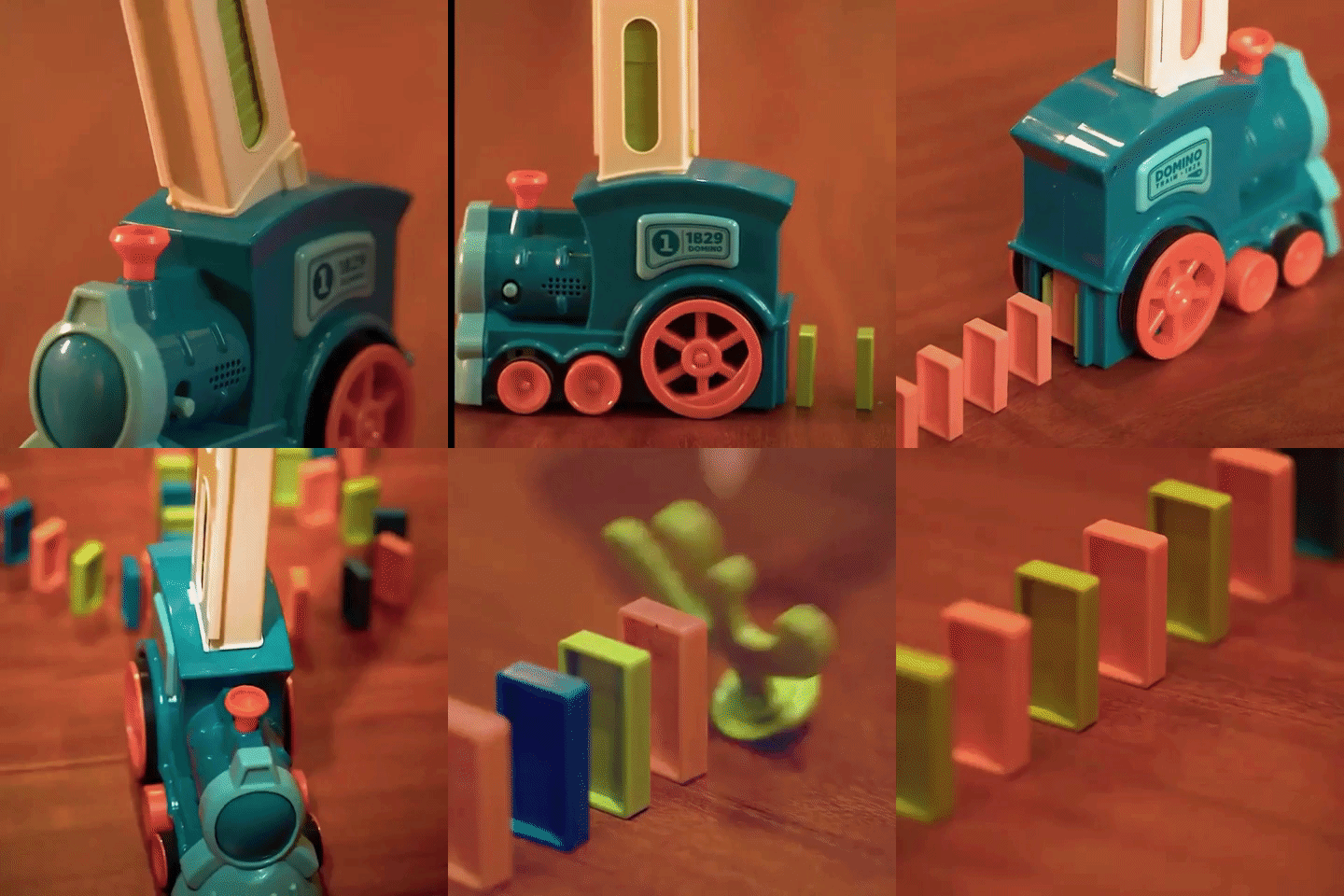
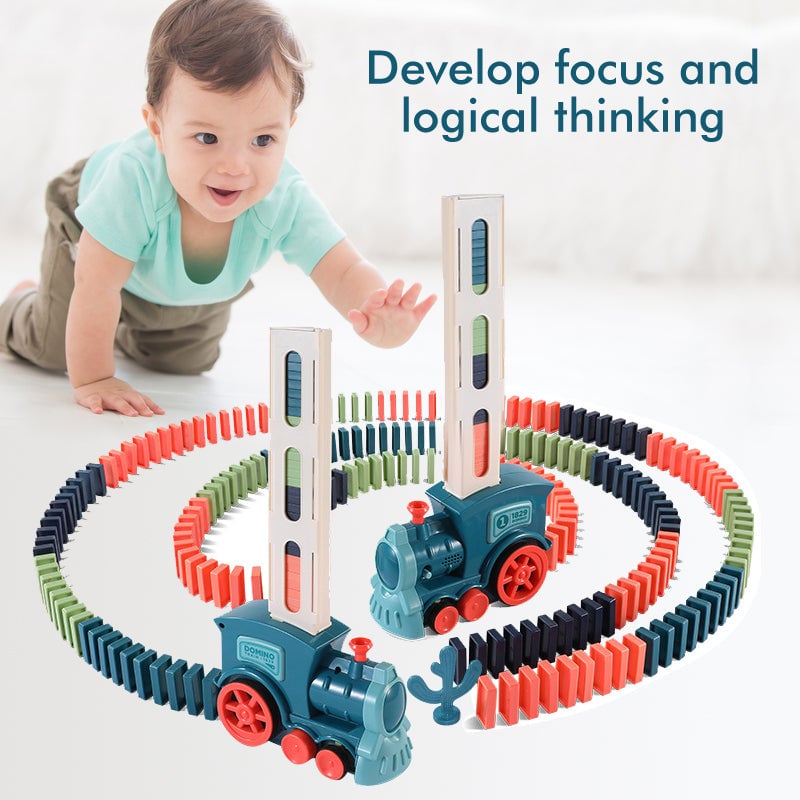
For children who enjoy movement and building, a domino train can combine several learning concepts into one activity.
The Love A Lotter Domino Train releases colorful dominoes as it moves, allowing children to create a line and then watch the dominoes fall in a chain reaction. The current product page recommends it for children ages 3 and up.
Skills It Can Encourage
- Cause-and-effect learning
- Spatial thinking
- Color recognition
- Counting
- Creativity
- Planning
Love A Lotter Recommendation
Domino Train
Because of the recommended age, this is a better choice for preschoolers and older children rather than younger toddlers.
6. Reusable Water Coloring Books
Coloring is a simple but valuable activity for developing early hand control.
The problem?
Toddlers and permanent markers aren't always the best combination.
Reusable water coloring books provide a mess-free alternative.
Children use a water pen to reveal colorful images, then the pages dry and can be used again.
Skills It Can Encourage
- Hand control
- Grip development
- Creativity
- Visual recognition
- Early drawing skills
Love A Lotter Recommendation
Magic Water Coloring Book
It's also a convenient option for travel, restaurants, waiting rooms, or quiet time at home.

7. Dinosaur Playsets
Educational play doesn't always need to look educational.
If your child loves dinosaurs, use that interest to encourage storytelling and creative thinking.
A dinosaur can become the main character in an adventure.
Children can create:
- Dinosaur rescue missions
- Prehistoric worlds
- Dinosaur races
- Jungle adventures
- Volcano stories
This type of pretend play encourages children to create their own narratives instead of simply following a predetermined storyline.
Skills It Can Encourage
- Imagination
- Storytelling
- Vocabulary
- Social play
- Creativity
8. Flexible Track Building Sets
Flexible track sets are particularly useful for children who enjoy vehicles.
Instead of giving children one fixed track, flexible pieces allow them to create different layouts.
They can make:
- Curves
- Loops
- Racing tracks
- Bridges
- Dinosaur worlds
- Obstacle courses
Every new design becomes a small problem-solving challenge.
Love A Lotter Recommendation
156PC Dinosaur World Road Race Flexible Track Playset
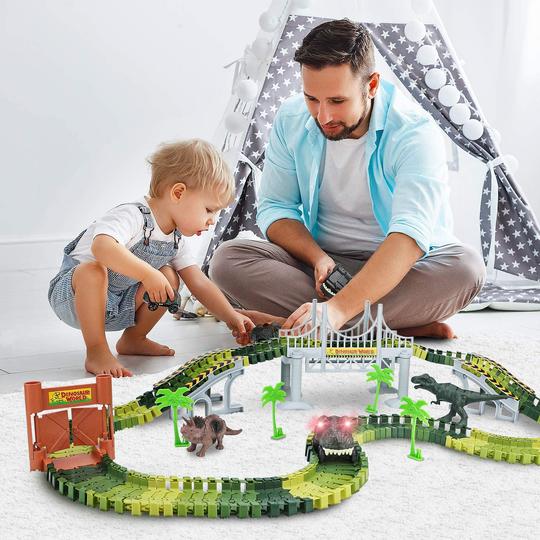
This combines dinosaur-themed imaginative play with building and track design.
9. Sorting and Matching Toys
Toddlers are naturally fascinated by similarities and differences.
Sorting toys let them explore concepts such as:
- Big vs. small
- Red vs. blue
- Same vs. different
- Shape matching
- Number matching
Start with simple tasks and gradually increase the challenge.
For example:
"Can you put all the red pieces together?"
Once they master that, try:
"Can you make a red-blue-red-blue pattern?"
Skills It Can Encourage
- Early math
- Pattern recognition
- Concentration
- Problem-solving
- Fine motor skills
10. Open-Ended Pretend Play Toys
Pretend play is one of the most powerful forms of learning for young children.
A simple toy can become almost anything.
A box becomes a house.
A toy car becomes a delivery vehicle.
A dinosaur becomes a superhero.
A felt character becomes the main character in a bedtime story.
The important part isn't the toy itself.
It's what the child does with it.
Skills It Can Encourage
- Imagination
- Communication
- Language
- Social skills
- Problem-solving
- Emotional development
Educational Toys vs. Electronic Toys
Parents often ask whether electronic toys are bad.
The answer isn't that simple.
Electronic toys can certainly be entertaining and some can support learning.
But there is a major difference between passive entertainment and active play.
With active play, the child has to do something.
They have to:
Choose → Touch → Experiment → Think → Create → Try Again
That process is one reason hands-on educational toys remain so valuable.
For families trying to reduce screen time, open-ended toys can also provide an alternative activity that doesn't rely on videos, apps, or constant stimulation.
For more ideas, read:
[The Best Screen-Free Toys for Curious Kids]
[INSERT INTERNAL BLOG LINK HERE]
How to Create an Educational Play Space at Home
You don't need an enormous playroom.
A small, organized area can be enough.
Try creating a simple rotation system.
Keep 4–6 Toys Available
Instead of putting every toy in front of your child, choose a small selection.
For example:
Creative
→ Felt Board
Fine Motor
→ Busy Board
Building
→ Blocks or Track Set
Imagination
→ Dinosaur Toys
Quiet Activity
→ Water Coloring Book
Then rotate toys every week or two.
This can make familiar toys feel new again without constantly buying something new.
How Parents Can Make Educational Toys More Effective
You don't need to turn playtime into school.
In fact, it's often better not to.
Instead of giving your child instructions all the time, try asking questions.
Instead of:
"Put the red piece here."
Try:
"Where do you think the red piece belongs?"
Instead of:
"Build a tower."
Try:
"How tall can you make it?"
Instead of:
"This is a dinosaur."
Try:
"Where do you think the dinosaur is going?"
These simple questions encourage children to think rather than simply follow instructions.
The Best Educational Toys Don't Feel Like School
This may be the most important thing to remember.
Toddlers don't need worksheets all day.
They need opportunities to explore.
They need opportunities to make mistakes.
They need opportunities to ask questions.
And they need opportunities to discover things for themselves.
A good educational toy simply creates the environment for those things to happen.
That's why a simple felt board can become a storytelling lesson.
A busy board can become a fine motor activity.
A track set can become an engineering challenge.
And a dinosaur can become the beginning of an entire imaginary world.
Final Thoughts: What Makes a Toy Truly Educational?
The best educational toys for toddlers aren't necessarily the most expensive or technologically advanced.
They're the toys that make children want to do something.
Build something.
Move something.
Create something.
Solve something.
Tell a story.
Try again.
When choosing toys for your toddler, look for products that encourage hands-on exploration, creativity, fine motor development, problem-solving, and independent thinking.
And most importantly, choose toys based on what your child is naturally curious about.
Because when a child is genuinely interested in something, learning happens naturally through play.
At Love A Lotter, we believe toys should do more than fill a toy box. They should give children opportunities to explore, imagine, create, and learn.
[SHOP EDUCATIONAL TOYS AT LOVE A LOTTER]
Frequently Asked Questions
What are the best educational toys for toddlers?
Some of the best educational toys for toddlers include Montessori busy boards, felt boards, bead games, stacking and sorting toys, building sets, coloring activities, and open-ended pretend-play toys.
The best choice depends on your child's age, abilities, and interests.
What toys help toddlers learn while playing?
Look for toys that encourage children to actively participate. Building, sorting, matching, threading, drawing, storytelling, and pretend play can all create valuable learning opportunities.
Are Montessori toys good educational toys for toddlers?
Yes. Montessori-inspired toys often focus on hands-on exploration, independence, concentration, fine motor skills, and problem-solving.
What are the best educational toys for a 2-year-old?
For a 2-year-old, consider age-appropriate busy boards, felt boards, large-piece sorting toys, building toys, simple bead activities, and creative toys that encourage hands-on exploration.
Always follow the manufacturer's recommended age range and supervise young children around small parts.
How can I make playtime more educational?
You don't need formal lessons. Ask open-ended questions, encourage your child to experiment, and let them find solutions independently.
For example, instead of showing your child exactly how to build something, ask, "What do you think will happen if we put this piece here?"
Are educational toys better than screen time?
Hands-on educational toys and screen-based activities serve different purposes. Educational toys provide opportunities for physical interaction, creativity, and active problem-solving. For families looking to reduce screen time, they can be a useful alternative to passive digital entertainment.
How many educational toys does a toddler need?
Toddlers don't necessarily need a large number of toys. A smaller collection of versatile, open-ended toys can provide plenty of opportunities for learning and imaginative play.
Rotating toys can also help keep familiar activities interesting.
Explore More Learning Through Play
Want more ideas for helping your child learn without making play feel like school?
Explore our other guides:
[10 Fine Motor Activities for Toddlers at Home]
[The Best Screen-Free Toys for Curious Kids]
[Montessori Learning Felt Board: The Screen-Free Toy That Sparks Creativity]
And explore the Love A Lotter collection for more Montessori-inspired, educational, creative, and screen-free toys for curious kids.